


Our NEWS
2026/05/20-22
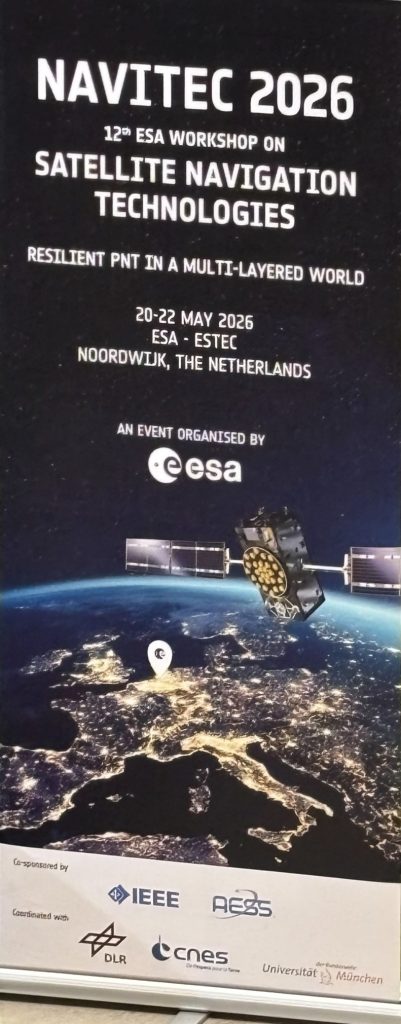
ABBIA GNSS Technologies participated to NAVITEC 2026 in ESA-ESTEC, Noordwijk , The Netherlands, in May.
We presented an R&D paper entitled «Real-Time Robust Factor Graph Optimization for GNSS Positioning: Performance Evaluation under Degraded Conditions».
Urban environments pose severe challenges to GNSS-based navigation due to frequent measurement degradation, motivating the need for robust estimation frameworks. Factor Graph Optimization (FGO) has recently emerged as a compelling alternative to the Extended Kalman Filter (EKF). While several studies have demonstrated the advantages of FGO in post-processing contexts, its potential benefits under real-time constraints remain largely unexplored. In this work, we implement a real-time compatible FGO-based Position, Velocity and Time (PVT) algorithm using the iSAM2 solver. The proposed frame-work integrates robust outlier mitigation to address measurement degradations. We evaluate the algorithm across five challenging urban driving scenarios and compare its performance against a robust Iterated EKF (IEKF) baseline. Experimental results show that FGO consistently outperforms the IEKF under real-time constraints, particularly under degraded measurement conditions. These findings highlight FGO as a strong alternative to EKF-based approaches for real-time urban GNSS navigation.
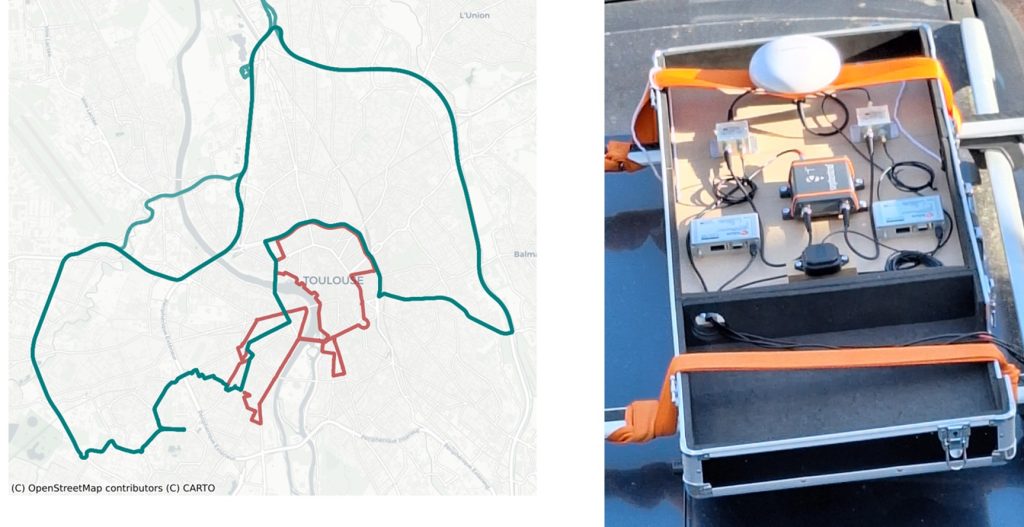
Our work proposed a real-time, low-latency FGO–based PVT algorithm designed to remain resilient under harsh urban environments conditions. Low latency was achieved using the iSAM2 algorithm in a fixed-lag smoothing setting. The algorithm was evaluated across several challenging urban scenarios, demonstrating convincing HPE performance, with a 95th percentile of 7.87 meters across scenarios. Benchmarking against a robust IEKF baseline confirmed the superiority of FGO, demonstrating a 46.5 % reduction in the 95th percentile HPE.
Although the EKF robustness can be improved through iterative updates, smoothing, or alternative modelling choices, such adaptations progressively narrow the conceptual and practical distinction with FGO. In contrast, FGO natively provides a unified framework in which smoothing, re-linearization and flexible modelling are naturally integrated.
These results highlight the strong potential of FGO for robust, real-time GNSS positioning in challenging urban environments.
Keywords— GNSS, Factor Graph Optimization, RTK, iSAM2, Robust Navigation, Fixed-Lag Smoothing, Urban Environments
2026/04/28-30
ABBIA DATA SCIENCE participated to ENC 2026 in Vienna, Austria, in April.
We presented an R&D paper entitled «Opportunities of Self Supervised Learning for GNSS: Evaluation of a Deep Learning-Enhanced PVT Algorithm».
This work proposes a Deep Learning Enhanced PVT algorithm to mitigate multipath interference in dense urban areas. A supervised objective jointly predicts range corrections and uncertainty, while a JEPA-based self-supervised pretraining stage improves representation quality. The algorithm is evaluated over diverse driving scenarios, substantially improving PVT accuracy, particularly for unseen harsh urban conditions. These results highlight the potential of unlabeled GNSS data to improve generalization performance.

Our work proposes an augmented Deep Learning PVT algorithm that substantially improves positioning accuracy, notably under unseen conditions. The supervised and self-supervised training methods were found to be effective, especially when employed together: the supervised objective predicts code corrections and uncertainty, while the SSL pretraining stage improves the coherence of predictions through higher-quality representations and reliance on robust features.
Future work will explore whether scaling unlabeled data alone can drive further generalization gains. More fundamentally, multipath is governed by physics and geometry. Self-Supervised Learning anchors deep neural net-works to this physical reality.
Keywords: Deep Learning, GNSS, Self Supervised Learning, JEPA, Multipath

2026/01/02
🎉 Abbia Celebrates 20 Years of Innovation and Partnership! 🎉
We are thrilled to announce that Abbia is celebrating its 20th anniversary!
Since our founding in 2006 in Toulouse, France, ABBIA has been driven by a passion for excellence in engineering, research, and innovation, especially in GNSS technologies, data science, and biomedical engineering.
This milestone is a tribute to the dedication of our talented team, the trust of our clients and partners, and our shared commitment to delivering innovative cutting-edge solutions. After years of pushing boundaries and embracing new challenges, we will strive to evolve while staying true to our core values of quality and collaboration.
Thank you to everyone who has been part of the Abbia journey. Your support inspires us to reach even greater heights.
The Abbia team.
2025/09/02
The European Space Agency (ESA) has acknowledged the work of ABBIA GNSS Technologies with an award presented during the commemorative event “30 Years of European Satellite Navigation”, held at the European Space Research and Technology Centre (ESTEC) in Noordwijk, the Netherlands, on 2 September. The award highlights ABBIA’s in recognition of its Excellence in GNSS Engineering, Commitment and long-standing Partnership leading to the success of European Satellite Navigation programmes.
The event, marking three decades since the launch of Europe’s satellite navigation initiative, brought together over a hundred representatives from institutions, member states, and companies, and featured the participation of ESA Director General Josef Aschbacher and ESA Director of Navigation Javier Benedicto.
Representing ABBIA GNSS Technologies, Bertrand Ekambi, its Founder-Manager, accepted the award during the ceremony. The company has expressed its gratitude for the recognition, which reflects its commitment to scientific excellence and collaboration in European space programmes.

2025/05/21-23
ABBIA DATA SCIENCE participated to ENC 2025 in Wroclaw, Poland, in May.
We presented an R&D paper entitled « Toward an Interpretable Multipath Error Model from GNSS Observables through the Application of Deep Learning ».
Multipath degradation of GNSS measurements is the main source of error in urban areas. Robust mitigation of this error source is still a challenge for standalone low-cost GNSS receivers. The complexity associated with the development of Multipath degradation models requires the use of advanced methods such as Deep Learning.


However, Deep Learning based mitigation methods tend to be hard to deploy due to a general lack of trust in their prediction due to their “black-box” behavior. This work tackles the notion of interpretability and generalization of Multipath degradation models obtained using Auto-Encoders.
We demonstrate the ability of Auto-Encoders to generate interpretable representations and to generalize to unseen situations.
Keywords: Data Science, GNSS, Deep Learning, Multipath, Self-Supervised Learning, Auto-Encoder, Interpretability